Discover
Reveal the visible and invisible conditions shaping performance.
Produces: shared diagnosis · priority constraints · clear focus

DEEP DIVE · THE INVISIBLE OPERATING SYSTEM
This is the full Aureus Alignment Framework — the intellectual architecture behind the overview. It is meant for evaluators, partners, and leaders who want to see how the pieces fit before a conversation.
THE CENTRAL PROBLEM
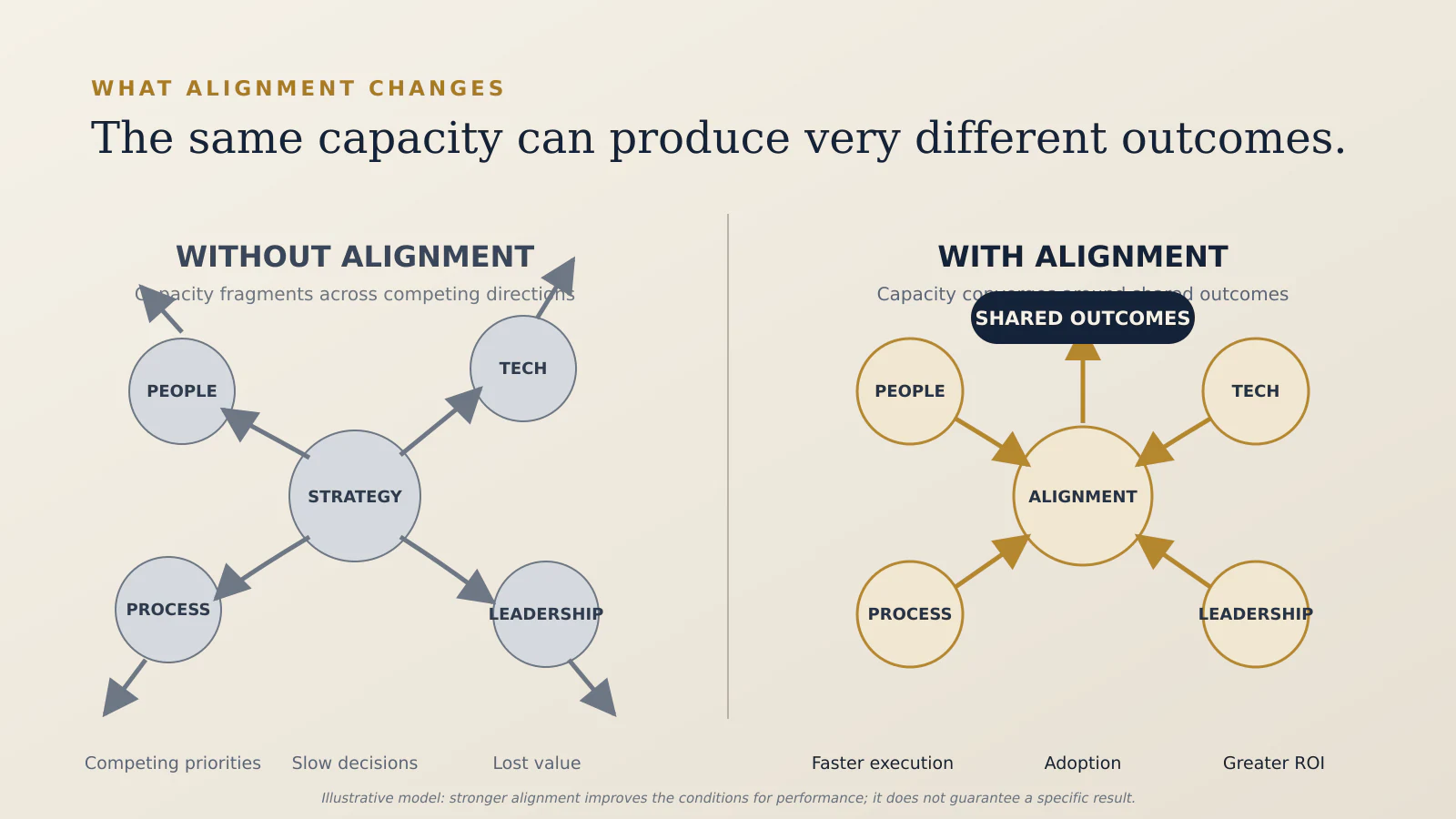
Organizations hold real resources — people, time, technology, capital, and experience — against continuous demand: customer commitments, growth, transformation, and strategic priorities. Performance depends on how well that demand is coordinated across available capacity.
THE AUREUS PERFORMANCE EQUATION™
Capacity represents the resources and capabilities available to the organization. Alignment represents the degree to which those assets are coordinated around shared outcomes, clear priorities, sound decisions, and accountable execution.
The value of capacity depends on the system through which it is directed.
ALIGNMENT IS THE LOAD BALANCER OF ORGANIZATIONAL PERFORMANCE™
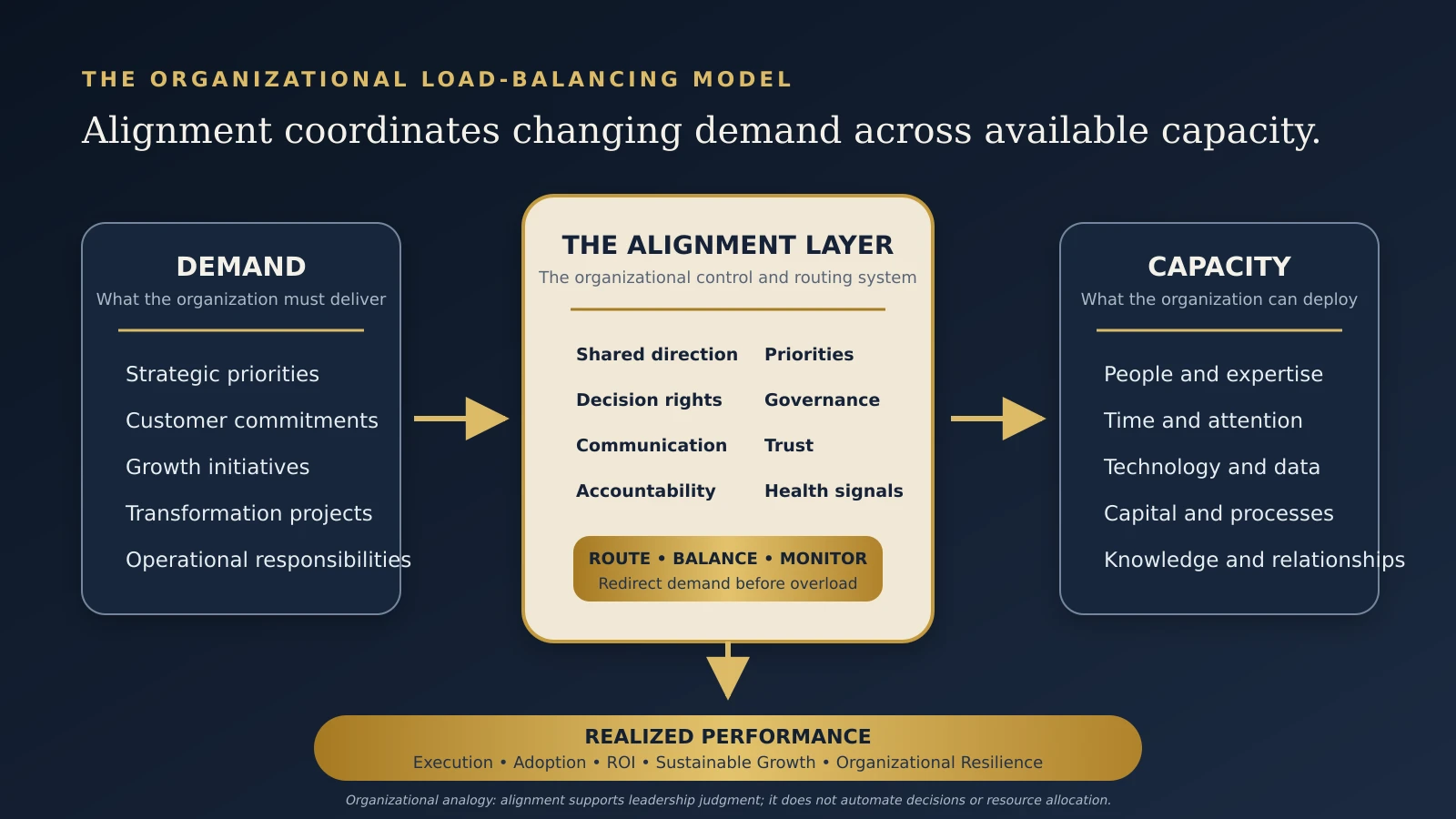
Much like a technology load balancer routes demand across available resources so no node fails under strain, organizations face the same underlying challenge — routing demand across finite capacity without overloading people or priorities.
ORGANIZATIONAL DEMAND
AVAILABLE CAPACITY
THE ALIGNMENT LAYER
A mature alignment system helps leaders see what matters most, where decisions belong, and when demand must be redirected before the organization overloads. It doesn't replace leadership judgment — it gives leaders a model for strengthening the organizational control layer.
ORGANIZATIONAL HEALTH SIGNALS
A dashboard may indicate that a team has available capacity. The people closest to the work may know that the team is already constrained by unclear priorities, rework, unspoken resistance, decision delays, or change fatigue.
The visible system reports what should be possible. The invisible system reveals what the organization can actually sustain.
HOW MISALIGNMENT APPEARS
Several priorities are described as equally urgent
Decisions repeatedly move upward or around formal owners
Teams optimize their function while weakening the overall outcome
Meetings create discussion without durable decisions
Technology is available but inconsistently adopted
Work is duplicated, delayed, or repeatedly reworked
Accountability is discussed but ownership remains ambiguous
Performance depends on a small number of overloaded individuals
These are not isolated failures of effort. They are signals that the organizational routing system requires attention.
THE AUREUS METHOD, IN FULL
Reveal the visible and invisible conditions shaping performance.
Produces: shared diagnosis · priority constraints · clear focus
Establish agreement around outcomes, priorities, decision rights, ownership, and measures of success.
Produces: shared direction · clear decisions · accountable ownership
Translate alignment into governance, operating cadence, communication, behavior, and execution.
Produces: readiness · coordinated action · stronger execution
Monitor outcomes, reinforce what works, and rebalance the system as demand and capacity change.
Produces: adoption · measurable value · sustained performance
ASSESSMENT BEFORE INVESTMENT™
FRAMEWORK BOUNDARIES